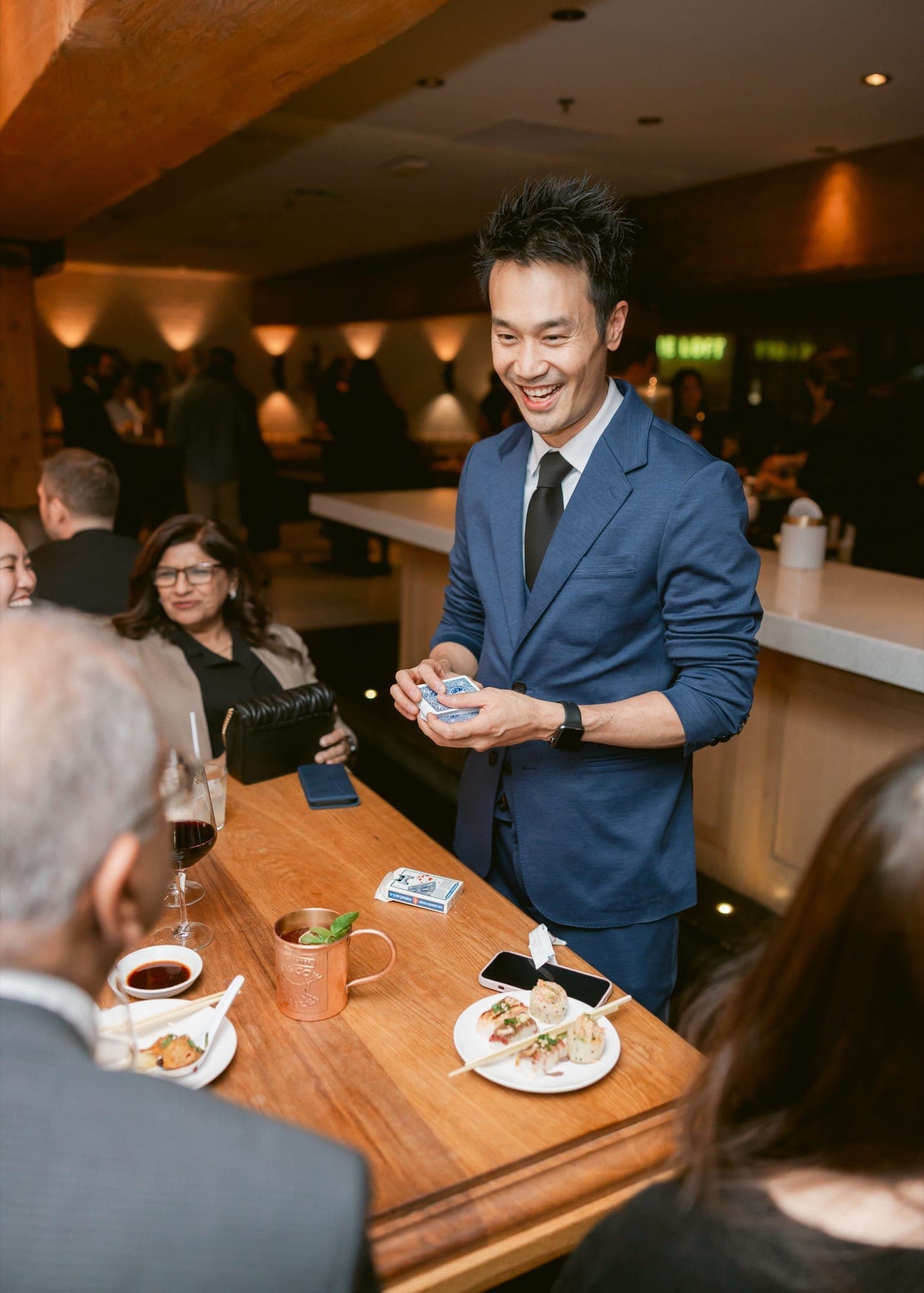
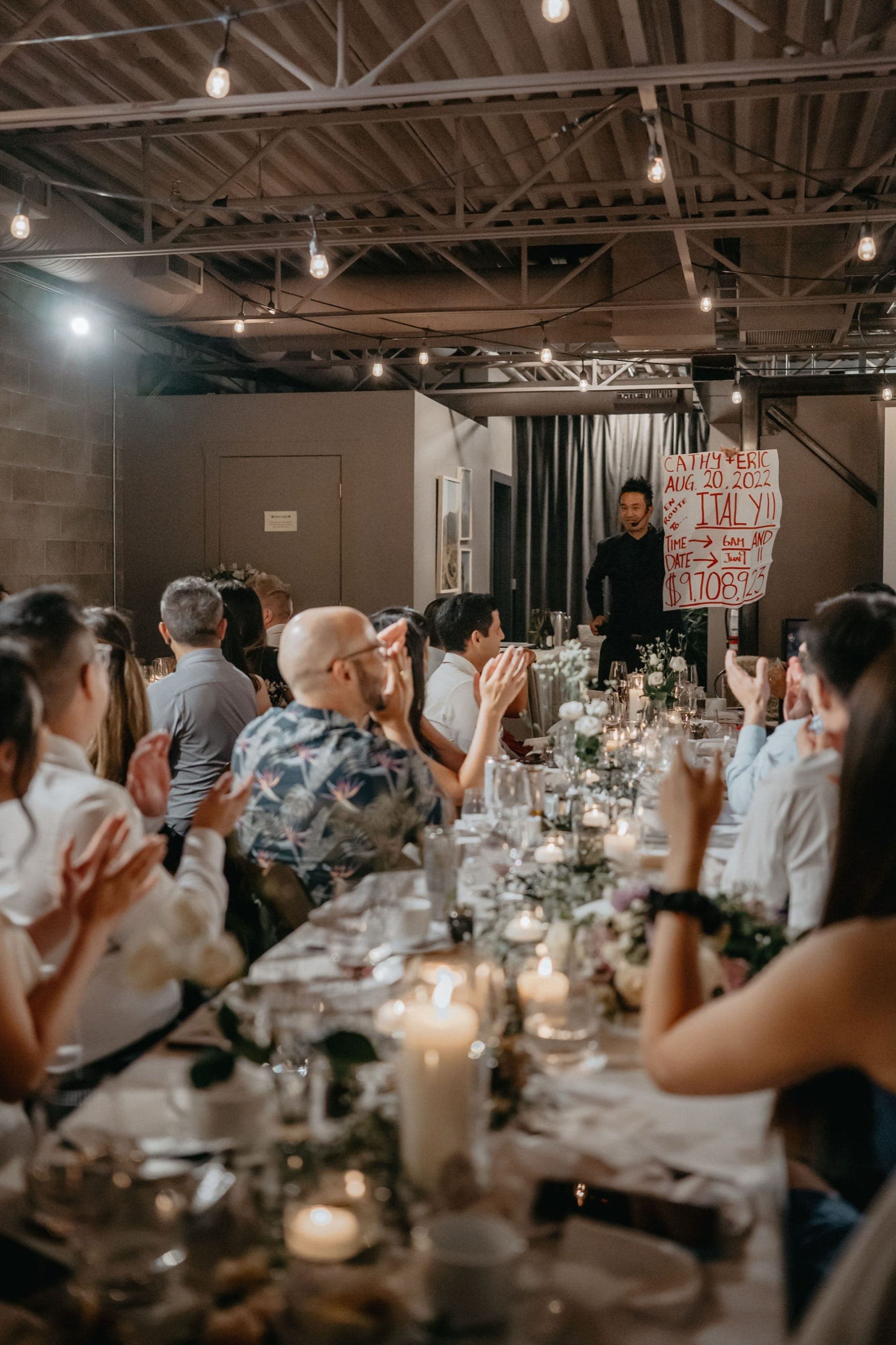
Most wedding entertainment is a slot. Ninety minutes of cocktail hour, or a set after dinner, or a stretch of hosting somewhere in the middle.
Cathy and Eric booked a Saturday. 2:30 in the afternoon to 10 at night, in a converted space in Strathcona, as a single package: MC and magic, one person, the whole day.
Nearly four years on it is still one of the weddings I bring up when a couple asks whether the combination is worth it, so it is worth writing down what actually made it work.
The venue told us how to run the day
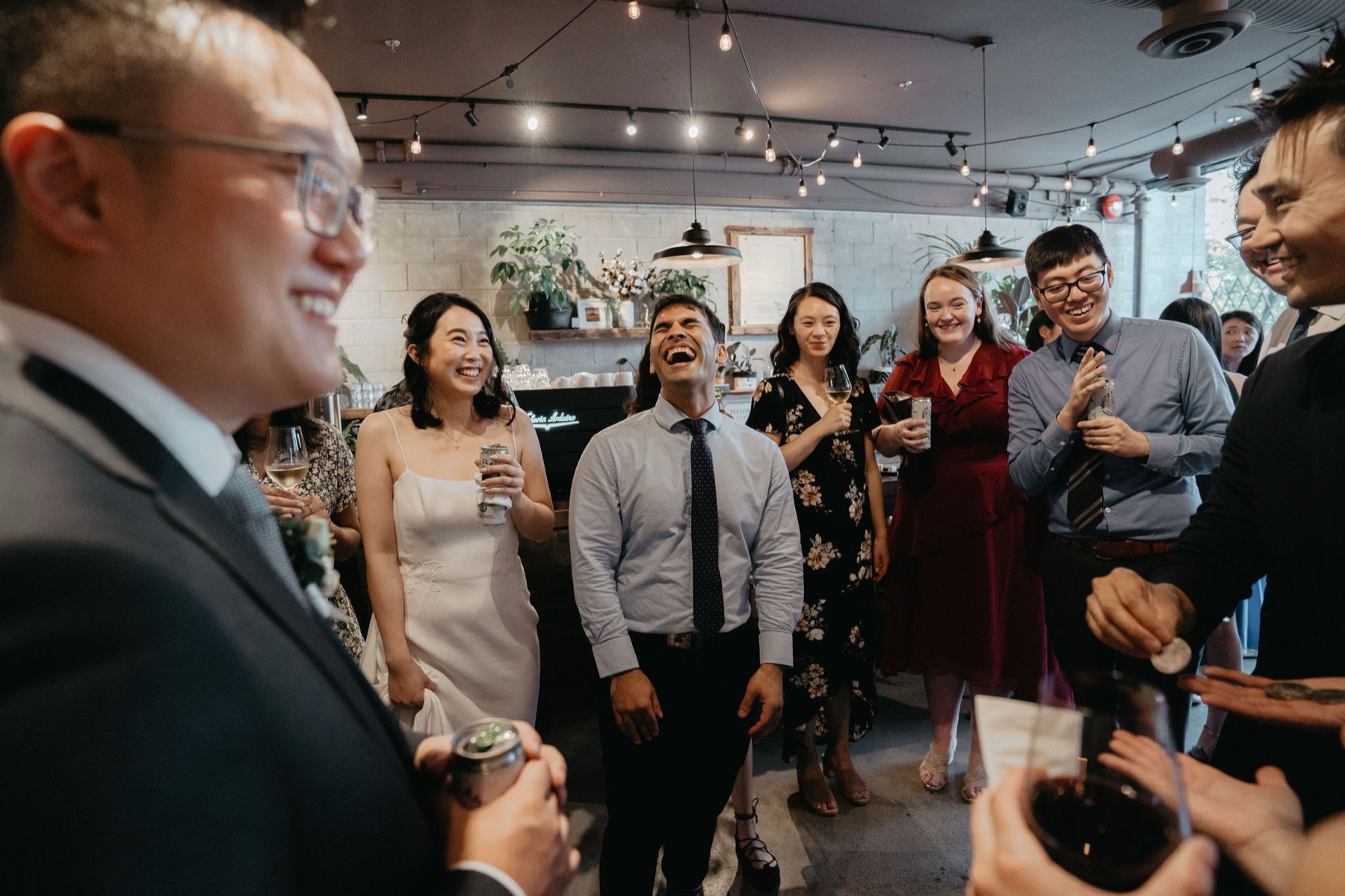
Strathcona is not ballroom country. These are brick and block warehouse conversions with exposed ductwork, string lights across the ceiling, a coffee machine in the corner and plants everywhere. Beautiful, characterful, and structurally the opposite of a hotel.
Which means: no stage. No riser. No sightlines. No back-of-house. Nowhere to put a hundred people in rows facing one direction, and nowhere for a vendor to disappear to between segments.
A lot of entertainment simply does not work in a room like that. A stage show needs the room to face one way, and this room does not have a "one way." Anything requiring AV is fighting a ceiling full of ductwork.
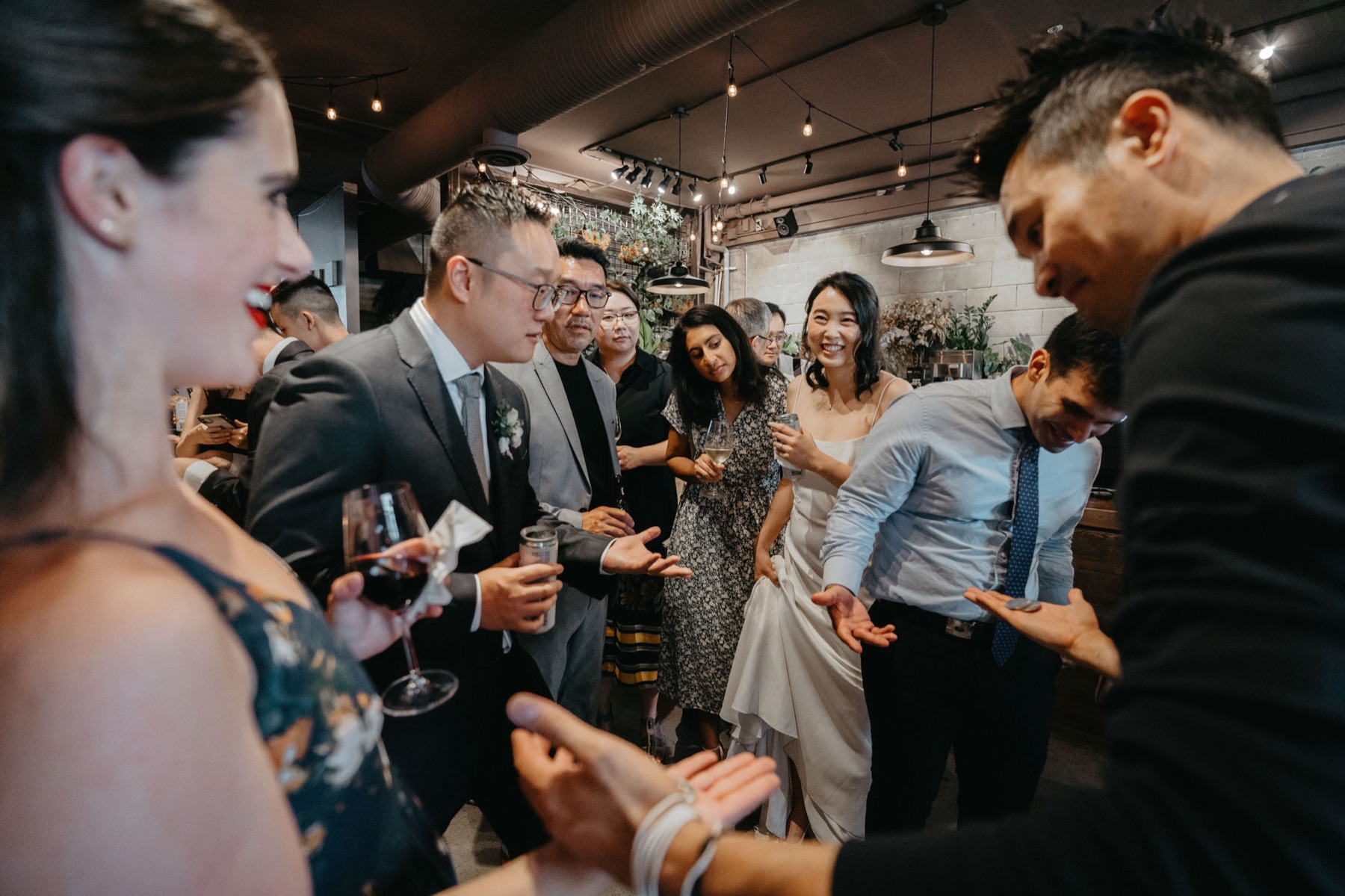
Close-up magic has the opposite problem, which is to say none. It happens in a circle, and a circle is the only shape this kind of room naturally makes.
Why the MC half mattered more here, not less
The instinct is that a relaxed warehouse wedding needs less hosting than a formal one. My experience is the reverse.
A hotel ballroom carries a wedding on its own. There is a head table, a dance floor, a clear front of room, and staff who have done this five hundred times. The architecture tells guests what is happening and where to look.
An industrial space tells them nothing. There is no obvious front, no visual cue that dinner is starting or speeches are about to happen. Without a voice guiding it, a room like that drifts pleasantly for seven hours and never quite peaks.
So the hosting is doing more work, not less. And because the same person is also the entertainment, there is no waiting to be introduced and no dead handoff between segments.
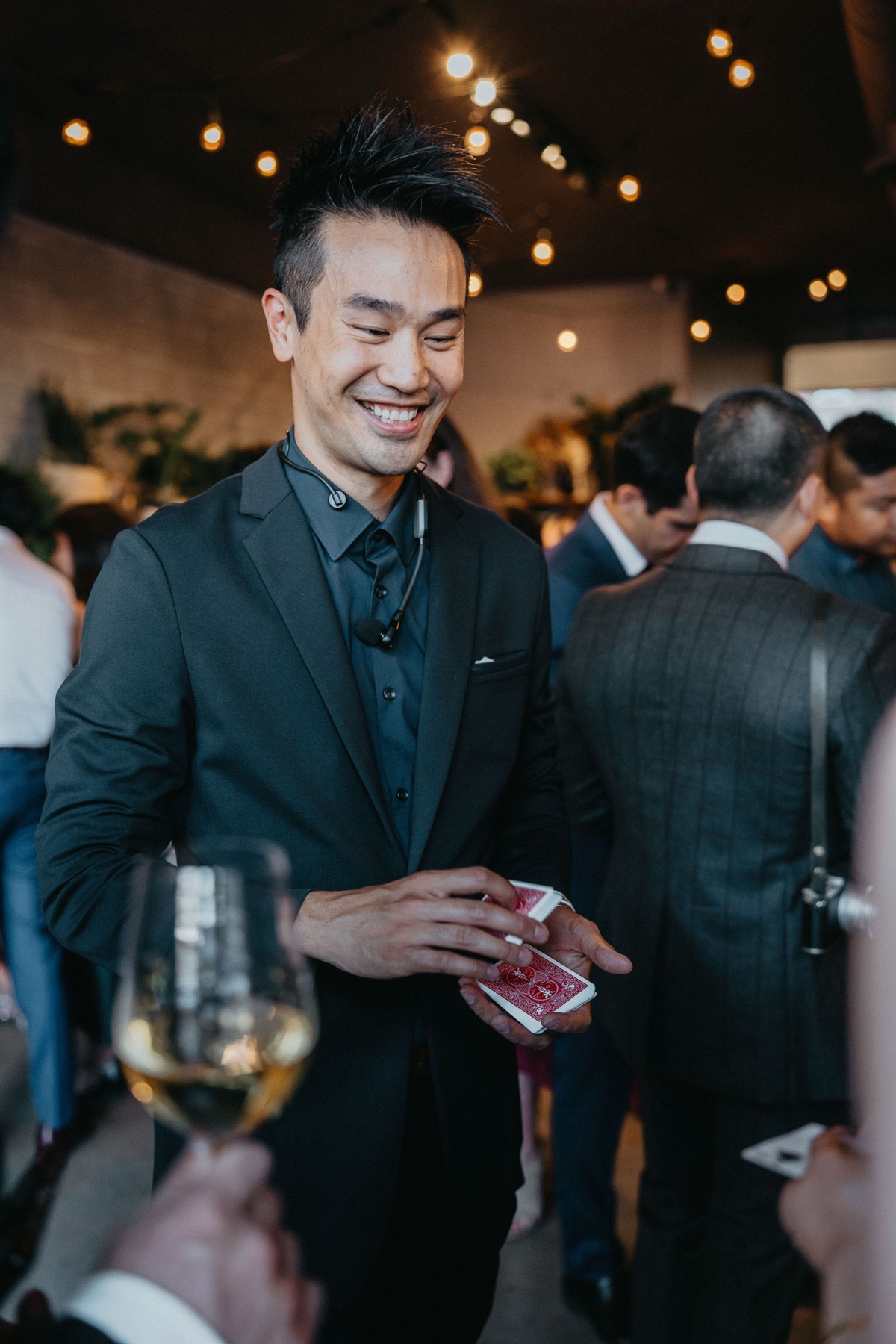
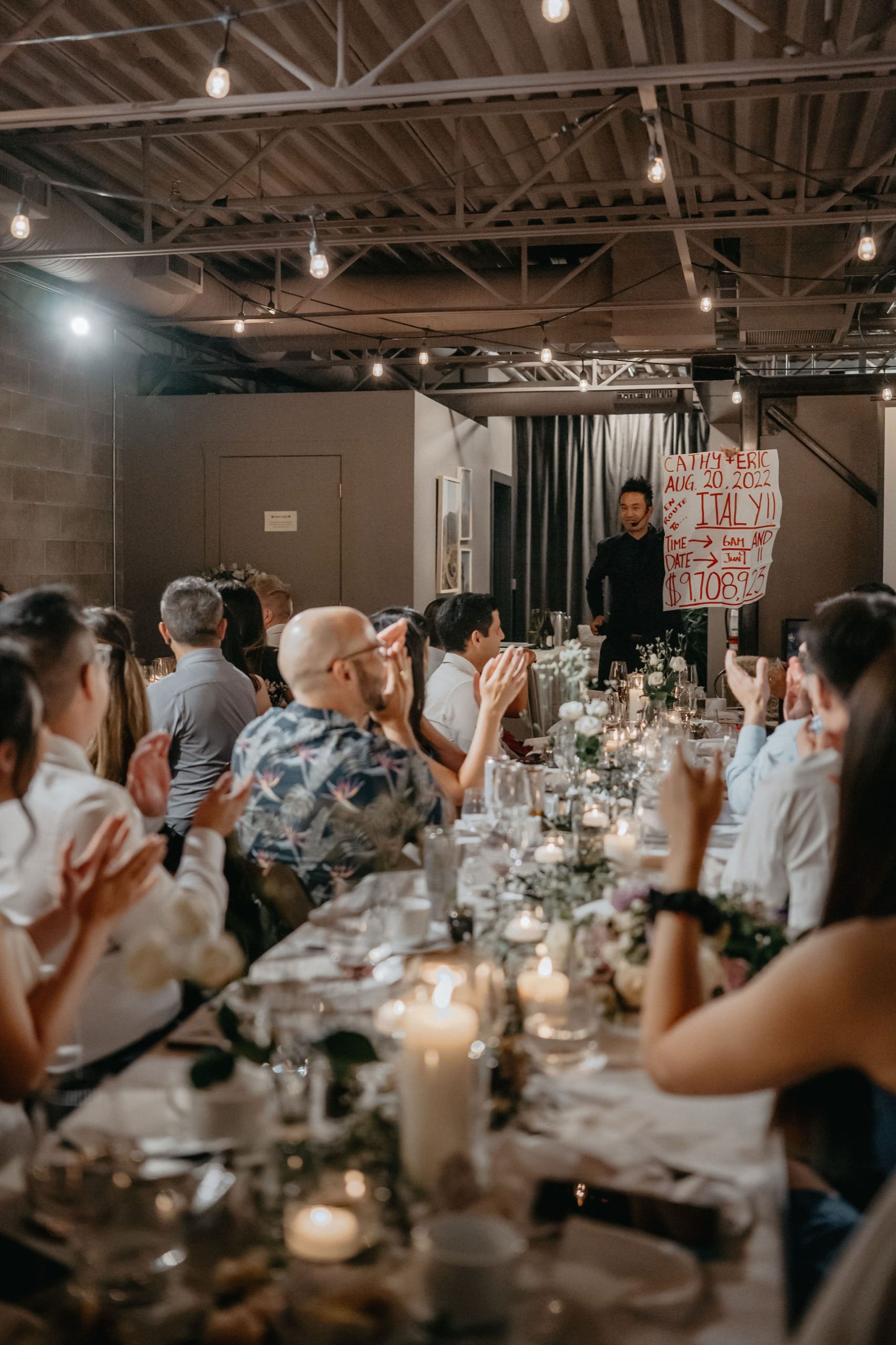
You can see it in the photographs: headset microphone on, deck of cards in hand, mid-conversation with a guest. That is the whole model in one frame. I am not the MC who steps aside for the entertainment, or the entertainer waiting to be announced. It is one job with two halves.
Seven and a half hours is a different brief
A slot booking is a performance. A full day is a shift, and it changes how you work.
You cannot go at full intensity from 2:30 to 10. Nobody can absorb that and nobody should try. What you do instead is manage a curve: light and warm as guests arrive, quieter through the ceremony and the meal, then building through the evening.
It also means you see the day the way the couple does. By the time the evening arrives I know which uncle is the loud one, which table has not spoken to anyone else, and who is going to enjoy being brought into something. That is impossible on a ninety-minute booking, and it is most of what makes a long booking worth more than the hours in it.
Should you book one vendor for the whole day?
Honestly, not always.
If your venue is a hotel with a coordinator, a stage and a house AV team, the room does a lot of the structural work and a slot booking may be all you need.
But if you have chosen a space with character rather than infrastructure — a warehouse, a gallery, a restaurant, anywhere without a stage and a clear front of room — then the thing you are missing is not entertainment. It is structure. And the cheapest way to buy structure is one person who is present all day, holds the microphone, and is also the reason people are gathering in circles.
The part that stayed with me
A year later I sent Cathy and Eric a note on their anniversary. They wrote back the same week:
"Thank you so much! We hope to see you and your magic again :)" — Cathy and Eric
Short, and worth more than a long review. A year after the day, with nothing being asked of them, they still wanted to see it again.
Photography by Monsielle Photography.
Frequently asked questions
Can a magician MC a whole wedding day?
Yes, and it suits some weddings much better than a slot booking. The practical requirement is preparation — run sheet, name list, pronunciations — and the practical benefit is that by evening the host knows the room, which no short booking allows.
What entertainment works in a warehouse or industrial wedding venue?
Anything that does not need a stage, sightlines or AV. Close-up magic is the clearest fit because it works in circles, which is the shape those rooms naturally make. Stage-based acts fight a space with no obvious front of room.
Do industrial venues need more hosting than hotels?
More, in my experience. A hotel ballroom signals what is happening through its own architecture. A converted warehouse does not, so a voice guiding the day is doing structural work rather than ceremonial work.
How long should a wedding magician be booked for?
It depends on the shape of your day. Ninety minutes covers a cocktail hour well. A full-day booking makes sense when there is no venue infrastructure to carry the structure, or when you want hosting and entertainment from the same person.